
AJAX makes easier to perform operations without submitting the form like – fetch, insert, delete records from MySQL database, file uploading, etc.
Using AJAX in WordPress is a little different. Here, need to consider two things –
- AJAX sent URL should be
admin-ajax.php. wp_ajaxaction hooks.
In this tutorial, I show how you can handle AJAX request in your WordPress theme.

Contents
1. Table Structure
I am using users table in the example.
CREATE TABLE `users` (
  `id` int(11) NOT NULL PRIMARY KEY AUTO_INCREMENT,
  `username` varchar(100) NOT NULL,
  `name` varchar(100) NOT NULL,
  `email` varchar(100) NOT NULL,
  `timestamp` timestamp NOT NULL DEFAULT CURRENT_TIMESTAMP ON UPDATE CURRENT_TIMESTAMP
) ENGINE=InnoDB DEFAULT CHARSET=latin1;
2. function.php
Open theme functions.php file.
Here, create a users_details_callback() function to handle AJAX requests.
- If request == 1 – Fetch all records from
userstable. - If request == 2 – Fetch record from
userstable according to$userid.
Define two actions in set patterns –
- wp_ajax_[action-name]
- wp_ajax_nopriv_[action-name]
[action-name] is users_details and pass users_details_callback method name as second parameter.
/* AJAX requests */
add_action( 'wp_ajax_users_details', 'users_details_callback' );
add_action( 'wp_ajax_nopriv_users_details', 'users_details_callback' );
function users_details_callback() {
  global $wpdb;

  $request = $_POST['request'];
  $response = array();
  // Fetch all records
  if($request == 1){
    $response = $wpdb->get_results("select id,username from users");
  }
  // Fetch record by id
  if($request == 2){
    $userid = $_POST['userid'];
    $response = $wpdb->get_results("select name,username,email from users where id=".$userid);
  }

  echo json_encode($response);
  wp_die();
}
3. Page Template
Create a new directory template and a newpage.php file.
HTML
A <select> element and <div id='userDetails'> container.
In the <select> add option using jQuery AJAX and display selected user details in <div id='userDetails'>.
Script
Define ajax_url variable and assign <?= admin_url('admin-ajax.php'); ?>.
Set 'action': 'user_details' and 'request': 1.
Send AJAX request where pass url: ajax_url, data: data. On successfully callback loop on response and append <option> in the <select>.
If value change in the <select> element then send AJAX request where pass selected value and on successful callback update <span> values.
Completed Code
<?php
/* Template Name: New page template */

get_header();
global $wp,$post,$wp_query;

?>
<div class='wrap'>
  <select id='sel_users'></select>

  <br/>
  <div id='userDetails' style='display: none;'>
   <table>
     <tr>
      <td>Name</td>
      <td>: <span id='span_name'></span></td>
     </tr>
     <tr>
      <td>Username</td>
      <td>: <span id='span_username'></span></td>
     </tr>
     <tr>
      <td>Email</td>
      <td>: <span id='span_email'></span></td>
     </tr>
   </table>
  </div>

</div>

<!-- Script -->
<script type='text/javascript'>
jQuery(document).ready(function($){
  var ajax_url = "<?= admin_url('admin-ajax.php'); ?>";

  var data = {
   'action': 'users_details',
   'request': 1
  };

  $.ajax({
    url: ajax_url,
    type: 'post',
    data: data,
    dataType: 'json',
    success: function(response){

      $('#sel_users').empty();
      $('#sel_users').append("<option value='0'>-- Select user --</option>");
      var len = response.length;
      for(var i=0; i<len; i++){
        var id = response[i].id;
        var username = response[i].username;

        // Add option
        var option = "<option value='"+id+"'>" + username + "</option>";
        $("#sel_users").append(option);
      }
    }
  });

  $('#sel_users').change(function(){
    var id = $(this).val();
    var data = {
     'action': 'users_details',
     'request': 2,
     'userid': id
    };

    $.ajax({
      url: ajax_url,
      type: 'post',
      data: data,
      dataType: 'json',
      success: function(response){

        var len = response.length;
        if(len > 0){
          $('#userDetails').show();

          $('#span_name').text(response[0].name);
          $('#span_username').text(response[0].username);
          $('#span_email').text(response[0].email);
        }else{
          $('#userDetails').hide();
        }
      }
    });
  });
});
</script>
<?php

get_footer();
4. Create new Page
- Login to WordPress Admin dashboard.
- Navigate to
Pages->Add New. - Select
New page templatefrom Page Attributes section.
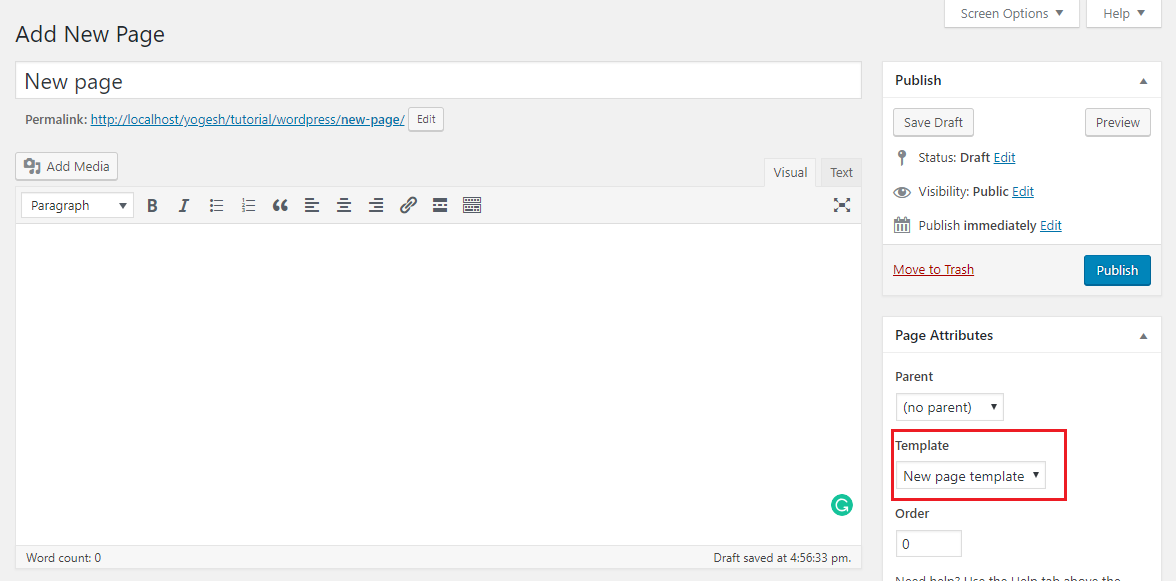
- Click Publish.
5. Output
It gives following output –

6. Conclusion
Create a new function in functions.php file to handle AJAX request and add actions wp_ajax_[action-name] and wp_ajax_nopriv_[action-name].
Now use your defined [action-name] in the jQuery.
Always end AJAX function with wp_die(), die(), or exit() methods.
If you found this tutorial helpful then don't forget to share.
Hi
I can’t get this to work. Am using a child theme so have tried adding part 2 above to both functions.php in the child theme and the parent theme.
Server log shows no errors.
The drop down menu on the page I have created lists no users.
What might I be doing wrong?
Thanks for your reply! I found the problem. Due to a type I was accessing an empty table in my DB. All working fine now 🙂
Second question. Would it be possible to use nonce to this?
Sorry pressed post too early. I meant to add that I had tried but got confused because as far as I can tell the correct way to do it would be to add it to the data array:
$ajax_data = array(
‘url’ => admin_url( ‘admin-ajax.php’ ),
‘nonce’ => wp_create_nonce( ‘my_nonce_here’ ),
);
But in your example, the array is in JS not PHP. Could it be done another way?
Thanks for that. I’m getting there!
In my page template I have:
jQuery(document).ready(function($) {
var nonce = $(‘meta[name=”csrf-token”]’).attr(‘content’);
$.ajaxSetup({headers: {‘X-CSRF-TOKEN’: nonce}});
});
then in functions.php I have
function add_general_nonce()
{
$nonce = wp_create_nonce( ‘my_general_nonce’ );
echo “”;
}
// To add to front-end pages
add_action( ‘wp_head’, ‘add_general_nonce’ );
// To add to admin pages
add_action( ‘admin_head’, ‘add_general_nonce’ );
and also in functions.php this:
function verify_general_nonce()
{
$nonced = isset( $_SERVER[‘HTTP_X_CSRF_TOKEN’] )
? $_SERVER[‘HTTP_X_CSRF_TOKEN’]
: ”;
if ( wp_verify_nonce( $nonced, ‘my_general_nnce’ ) ) {
echo “alert(‘”. $_SERVER[‘HTTP_X_CSRF_TOKEN’] . “‘)”;
die();
}
}
And in my admin-ajax.php I have:
function my_action() {
verify_general_nonce();
}
add_action( ‘wp_ajax_nopriv_my_action’, ‘my_action’ );
add_action( ‘wp_ajax_my_action’, ‘my_action’ );
The drop down menu works, but I don’t get an error if I change ‘my_general_nonce’ to something else in wp_verify_nonce. It’s as if verify nonce isn’t working?
Many thanks for any ideas!!
how come i cannot set session variables in my ajax wordpress code
I used the BAuth instead of AJAX ….. It worked well i realised my problem was the simple membership plugin that would pre-empt my sessions. So i used this option and it worked like Magic. Thank tou
$auth = BAuth::get_instance();
if ($auth->is_logged_in())
{
}
Thank you very much!
This is a good data.
I got much knowledge.Thank you again.
Gregory.
Thanks Man!
only your tutorial worked, loved ya!
Thanks . Nice tutorial. By the way when open the page default for (–select user–) it is not showing all the records. However filter is fine.